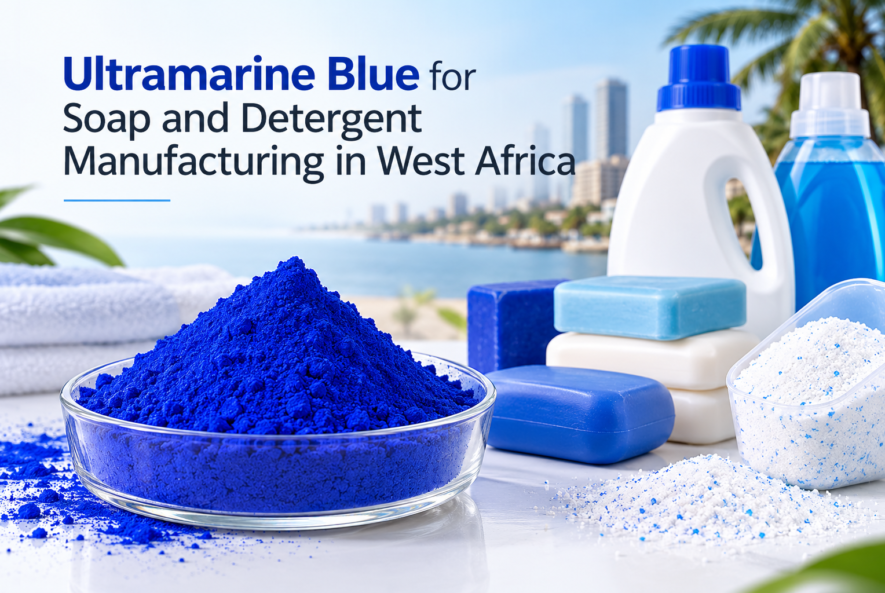
Colour plays an important role in the soap and detergent industry. Manufacturers need to create products with an appearance that matches their brand, formulation, and customer expectations. Ultramarine Blue is a pigment used in various applications, including soap and detergent production, where it can contribute to the desired shade or help counter unwanted yellowish tones.
For manufacturers across West Africa, choosing Ultramarine Blue for soap and detergent manufacturing involves more than selecting a colour. Buyers also need to consider the product formulation, pigment compatibility, dispersion, quality consistency, packaging, and supply arrangements.
Understanding these factors can help manufacturers make informed purchasing decisions and maintain consistent production standards.
What Is Ultramarine Blue?
Ultramarine Blue is a blue inorganic pigment known for its distinctive colour. Unlike a soluble dye, a pigment is generally dispersed throughout a material rather than dissolved in it. Its suitability depends on the application and the properties required in the finished product.
In soap and detergent manufacturing, Ultramarine Blue can be used to achieve a particular blue shade or, in suitable formulations, to counter the appearance of yellowish tones. The quantity required and the final colour depend on the formulation, pigment grade, processing conditions, and intended product appearance.
Manufacturers should not assume that every Ultramarine Blue grade is suitable for every application. The intended use, technical specifications, and compatibility with the finished product should be confirmed before production.
How Is Ultramarine Blue Used in Soap and Detergent Manufacturing?
Ultramarine Blue can serve different purposes depending on the product being manufactured. The formulation and processing method determine how the pigment performs.
1. Bar Soap Production
Bar soap manufacturers may use Ultramarine Blue when a blue shade forms part of the product design. The pigment can help achieve a consistent colour when it is compatible with the soap base and properly dispersed.
The required amount depends on the desired shade and the characteristics of the formulation. Manufacturers should conduct small-scale trials before using the pigment in a full production batch.
It is also important to check whether the pigment remains suitable under the processing conditions and within the finished soap’s intended pH range.
2. Laundry Soap Manufacturing
Laundry soap products may use colour to distinguish one product variant from another or to support a particular brand identity. Ultramarine Blue may be considered for formulations that require a blue pigment.
However, the pigment grade must be suitable for the intended laundry application. Manufacturers should evaluate colour consistency, dispersion, compatibility with other ingredients, and stability during storage.
A controlled production process can help reduce visible colour variations between batches.
3. Powder Detergent Production
Powder detergents may contain colourants as part of their formulation. Ultramarine Blue can be considered when a suitable blue pigment is required, including for certain product designs or formulations intended to counter a yellowish appearance.
Uniform distribution is an important consideration. Poor dispersion can result in uneven colour or visible blue spots in the finished powder.
Manufacturers should evaluate the pigment using their actual detergent base and mixing process. They should also check whether the colour remains consistent after packaging and storage.
4. Liquid Detergent Formulations
Liquid detergents have different formulation requirements from powder detergents and bar soaps. A pigment that performs well in one product may not be suitable for another.
Before using Ultramarine Blue in a liquid detergent, manufacturers should assess dispersion, suspension, settling, compatibility with surfactants, and the overall stability of the formulation.
The pigment should be selected according to the intended product and its technical requirements rather than colour alone.
What Are the Main Benefits of Using Ultramarine Blue?
The potential benefits depend on the pigment grade and the manufacturing process. For suitable applications, Ultramarine Blue offers several practical advantages.
Control Over Product Appearance
Colour helps manufacturers distinguish products within a range. A suitable blue pigment can support the intended appearance of soap and detergent products.
Support for Brand Consistency
Manufacturers often need to maintain a similar shade across production batches. Selecting an appropriate pigment and controlling its dosage and dispersion can help achieve more consistent results.
Formulation Flexibility
Ultramarine Blue can be considered for different product types, provided the grade is appropriate for each application. Soap, laundry detergent, powder detergent, and liquid detergent formulations may require different testing procedures.
Potential Colour Correction
In suitable formulations, Ultramarine Blue may help counter unwanted yellowish tones. The result depends on the starting colour, dosage, pigment properties, and other ingredients.
It should not be treated as a substitute for formulation testing. Manufacturers need to confirm the finished product’s appearance under their actual production conditions.
How Should Manufacturers Select Ultramarine Blue?
Choosing a suitable pigment requires technical evaluation and clear communication with the supplier. The following checks can help procurement and production teams assess their options.
1. Confirm the Intended Application
Start by identifying whether the pigment will be used in bar soap, laundry soap, powder detergent, or liquid detergent.
Share the intended application with the supplier and request confirmation that the proposed grade is suitable for it.
2. Review Technical Specifications
Request the relevant technical data sheet and product specifications. Depending on the application, these may cover colour characteristics, physical properties, and other parameters relevant to production.
Do not rely on a product name or colour sample alone when making a purchasing decision.
3. Check Compatibility With the Formulation
The pigment should be evaluated alongside the other ingredients in the formulation. Manufacturers should consider factors such as pH, processing temperature, mixing method, and storage conditions where relevant.
Small-scale testing can help identify potential issues before the pigment is introduced into routine production.
4. Evaluate Dispersion and Colour Consistency
Uneven dispersion can affect the appearance of the finished product. Manufacturers should assess the mixing procedure, pigment dosage, and resulting shade.
For recurring production, documenting the approved formulation and process parameters can help reduce batch-to-batch variations.
5. Confirm Packaging and Supply Requirements
Before placing an order, buyers should confirm available packaging, order quantities, delivery arrangements, documentation, and expected lead times.
These details are particularly relevant when sourcing industrial chemicals and pigments across international markets.
Sourcing Ultramarine Blue for Soap and Detergent Manufacturing in West Africa
West African manufacturers and distributors may source raw materials through local suppliers or international trading partners. The right option depends on order volume, delivery requirements, technical needs, and purchasing arrangements.
When evaluating an international supplier, buyers should consider the following points:
- Product suitability: Confirm that the pigment grade matches the intended soap or detergent application.
- Technical documentation: Request the available product specifications and relevant technical documents.
- Quality consistency: Discuss how product specifications are maintained across repeat orders.
- Packaging requirements: Confirm that the proposed packaging suits storage, handling, and transport needs.
- Import documentation: Check the documents required by the destination country and the importing business.
- Lead times: Confirm production availability, dispatch schedules, shipping arrangements, and estimated delivery times.
- Communication: Ensure that the supplier can clearly address technical questions and order requirements.
Import requirements and documentation can differ between countries in West Africa. Buyers should confirm the applicable rules with their customs broker or relevant authorities before arranging a shipment.
Price is another purchasing consideration, but it should not be evaluated in isolation. The pigment’s suitability, consistency, documentation, order size, freight, and total landed cost all affect the overall buying decision.
Common Mistakes to Avoid When Purchasing Ultramarine Blue
A few avoidable mistakes can create problems during formulation and production.
Choosing a pigment based only on price: A lower purchase price does not establish whether a grade is suitable for the intended application. Compare specifications and test the material before approving it.
Using the same grade for every formulation: Soap, powder detergent, and liquid detergent have different requirements. Confirm suitability for each intended use.
Skipping trial batches: Testing helps identify colour and dispersion issues before full-scale manufacturing.
Ignoring storage and handling: Follow the supplier’s handling and storage guidance. Poor storage practices can affect the condition of raw materials.
Leaving specifications undefined: Buyers should document the agreed product grade and relevant quality requirements to support repeat orders.
ASA Impex and Ultramarine Blue Applications
ASA Impex is a manufacturer, exporter, and supplier of industrial chemicals and pigments. Its product portfolio includes Ultramarine Blue, alongside products such as Sodium Metabisulfite, Sodium Bisulfite, Soda Ash Light, and Sodium Sulphate.
Manufacturers considering Ultramarine Blue for soap and detergent manufacturing can review the company’s Ultramarine Blue application information to understand its application focus.
For purchasing decisions, buyers should communicate their intended use, technical requirements, quantity, packaging needs, and destination market. These details help establish whether the available product is appropriate for the intended manufacturing process.
Frequently Asked Questions
1. What is Ultramarine Blue used for in soap manufacturing?
Ultramarine Blue is used as a pigment to achieve a desired blue shade in suitable soap formulations. It may also help counter yellowish tones in certain applications. The result depends on the pigment grade, formulation, and dosage.
2. Can Ultramarine Blue be used in detergent manufacturing?
It can be considered for suitable powder or liquid detergent formulations. Manufacturers should confirm grade suitability and evaluate dispersion, compatibility, and product stability before use.
3. How do I choose Ultramarine Blue for detergent production?
Review the intended application, technical specifications, compatibility with the formulation, dispersion behaviour, and required colour. Conduct a trial batch before approving the pigment for regular production.
4. What should West African buyers check before importing Ultramarine Blue?
Buyers should confirm product specifications, packaging, order quantities, shipping timelines, available documentation, total landed cost, and the import requirements of the destination country.
5. Does Ultramarine Blue work the same way in soap and liquid detergent?
No. The performance of a pigment depends on the formulation and processing conditions. Liquid detergents may require particular attention to dispersion, suspension, and settling, while soap formulations have their own compatibility requirements.
6. Where can manufacturers find information about Ultramarine Blue applications?
Manufacturers can review relevant supplier product information and technical documentation. ASA Impex provides an Ultramarine Blue applications page for readers seeking further product-related information.
Final Takeaway
Ultramarine Blue can support colour requirements in suitable soap and detergent formulations, but selecting the right grade requires more than matching a shade. Manufacturers need to assess application suitability, dispersion, formulation compatibility, technical specifications, and supply arrangements.
For businesses sourcing Ultramarine Blue for soap and detergent manufacturing in West Africa, a clear product specification and a trial batch can help reduce purchasing uncertainty. Reviewing the supplier’s documentation and confirming import requirements before placing an order can also support a more reliable procurement process.
If your business is evaluating Ultramarine Blue for soap or detergent production, review the available application information from ASA Impex and confirm your technical and purchasing requirements before proceeding.