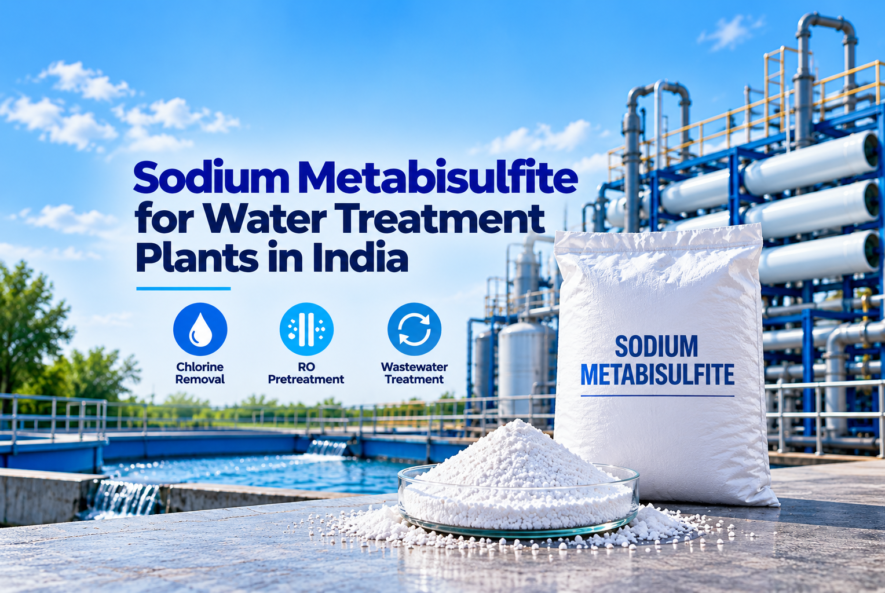
Sodium metabisulfite is used in water treatment plants mainly to remove residual chlorine from water before it reaches processes or equipment that are sensitive to oxidising agents. It is especially relevant in reverse osmosis (RO) systems, where free chlorine can damage certain membrane materials. Treatment plants may also use it for dechlorination in selected wastewater applications.
For businesses looking for a sodium metabisulfite supplier in India, the buying decision should consider more than price. Product specifications, intended application, documentation, storage conditions and dependable supply all matter. The chemical must also be suitable for the particular treatment process and its water-quality requirements.
What Is Sodium Metabisulfite?
Sodium metabisulfite is an inorganic chemical compound with the formula Na₂S₂O₅. It is commonly supplied as a solid powder or crystalline material and is used in several industrial processes because of its reducing properties.
When sodium metabisulfite dissolves in water, it forms bisulfite species that can react with residual chlorine. This makes it useful in dechlorination systems where chlorine needs to be reduced before the water moves to the next treatment stage.
Its suitability depends on the intended use. A chemical grade suitable for one industrial process should not automatically be assumed suitable for every water-treatment application, particularly when treated water is intended for drinking or other regulated uses.
How Is Sodium Metabisulfite Used in Water Treatment Plants?
The main water-treatment application is dechlorination—the reduction or removal of residual chlorine from water. The chemical may be used in industrial water systems, wastewater treatment processes and pretreatment stages for membrane systems, depending on the plant design.
1. Removing residual chlorine
Chlorine is commonly used to control microorganisms in water systems. However, residual chlorine can be undesirable at later stages of treatment. Sodium metabisulfite reacts with chlorine through its dissolved reducing species, helping reduce the chlorine residual.
The dosing point depends on the plant’s process design. Operators need to confirm where chlorine removal is required and measure the residual at the appropriate point after dosing.
2. Protecting reverse osmosis membranes
Reverse osmosis is used to reduce dissolved salts and other constituents in water. Some RO membranes, particularly certain thin-film composite membranes, are sensitive to free chlorine.
If chlorinated feed water reaches a chlorine-sensitive membrane, oxidation can affect membrane performance and service life. Sodium metabisulfite is therefore used in some RO pretreatment systems to remove free chlorine before the water enters the membrane stage.
The plant should follow the membrane manufacturer’s guidance for allowable chlorine exposure, chemical compatibility, dosing location and monitoring.
3. Supporting wastewater dechlorination
Some wastewater treatment plants disinfect treated effluent with chlorine before discharge. Where residual chlorine must be reduced, sodium metabisulfite can be used as a dechlorination chemical.
The required treatment depends on the chlorine residual, the flow rate, the discharge requirements and the design of the dosing and mixing system. Operators must also avoid excess chemical dosing because leftover reducing agent can affect water quality, including dissolved oxygen in the receiving water.
4. Use in other industrial water systems
Industrial facilities may have different water-treatment requirements depending on their processes. Sodium metabisulfite may be considered where a reducing agent is required, but it is not a universal solution for every water-quality issue.
It does not replace filtration, softening, membrane separation, disinfection or other treatment stages where those processes are required. The chemical should be selected for a defined treatment purpose.
How Does Sodium Metabisulfite Work During Dechlorination?
When sodium metabisulfite is added to water, it forms bisulfite species. These species react with free chlorine and reduce it to chloride-containing products.
The overall process is affected by several operating conditions:
- Chlorine residual: Higher chlorine levels generally require more dechlorinating chemical.
- Water flow: The dosing system must account for changes in flow through the plant.
- Mixing: The chemical needs to disperse adequately through the water for the reaction to occur.
- Contact time: The process must allow sufficient time for the reaction before the water reaches the next stage.
- Monitoring: Operators need suitable measurements to confirm that the target residual has been achieved.
A theoretical chemical requirement can help with preliminary calculations, but it should not be treated as a universal operating dose. Actual dosing must be established using water analysis, the system design, product specifications and validated operating procedures.
What Should Buyers Check Before Purchasing Sodium Metabisulfite?
A water treatment plant should assess the chemical against its process requirements before placing an order. The following checks can help procurement teams compare suppliers and reduce avoidable problems.
1. Confirm the intended application
Tell the supplier whether the product is required for RO pretreatment, industrial dechlorination, wastewater treatment or another defined process. This helps establish the relevant grade and documentation requirements.
For drinking-water treatment or other regulated uses, confirm the applicable requirements with the responsible plant engineer or regulatory authority. Do not assume that a general industrial grade is automatically approved for potable-water treatment.
2. Request the technical documents
Ask for the current Technical Data Sheet (TDS) and Safety Data Sheet (SDS). Depending on the application, you may also need a Certificate of Analysis (CoA) for the supplied batch.
Review the product’s stated assay or purity, relevant impurities, physical form, packaging information and handling requirements. Compare the documents with your plant’s approved purchasing specification.
3. Check batch consistency and traceability
If the treatment process depends on controlled chemical dosing, variations in product quality can affect operating calculations. Ask how batches are identified and what batch-specific quality documents are available.
Keep purchase records and retain the documents associated with each delivery according to your site’s quality procedures.
4. Review packaging and storage requirements
Packaging should be appropriate for the product, transportation conditions and intended storage period. Sodium metabisulfite needs protection from moisture and should be stored according to the supplier’s SDS.
Confirm the pack size, handling arrangements and expected delivery schedule before finalising the purchase.
5. Compare the complete quotation
A useful quotation should make the commercial terms clear. Compare the quoted grade, quantity, packaging, applicable taxes, freight, delivery location and lead time—not just the price per kilogram.
For ongoing plant operations, discuss expected consumption and order planning with the supplier so that procurement can align with the plant’s actual demand.
How to Choose a Sodium Metabisulfite Supplier in India
A suitable supplier should be able to discuss the intended application and provide clear information about the product being offered. Use these questions when evaluating potential suppliers:
- Can the supplier confirm the product grade and specifications?
- Are the TDS and SDS available for review?
- Can batch-specific documentation be provided when required?
- Are packaging options and order quantities suitable for the plant?
- Are delivery terms and lead times clearly stated?
- Can the supplier clarify which details must be confirmed before the order is placed?
For procurement teams sourcing sodium metabisulfite in India, these checks help create a more consistent purchasing process. They also make it easier to compare quotations on an equivalent basis.
Storage and Handling Considerations
Correct storage helps maintain product quality and supports safer plant operations. Always follow the current SDS and the site’s chemical-handling procedures.
Key precautions include:
- Store the product in a cool, dry and appropriately ventilated area, as specified by the supplier.
- Keep packaging closed when the material is not being used and protect it from moisture.
- Use suitable personal protective equipment and avoid creating or inhaling dust.
- Keep the product clearly labelled and manage it under the site’s chemical inventory procedures.
- Follow the SDS instructions for incompatible materials, spills, first aid and disposal.
- Prepare and use solutions according to the plant’s approved procedure. Do not assume a prepared solution will retain its original strength indefinitely.
Operators should also monitor the treatment process after dosing. Chemical addition alone does not confirm that the target chlorine residual has been reached.
Common Mistakes to Avoid
Choosing only on price: A low quotation may not represent the same grade, documentation or delivery terms as another offer.
Using a standard dose for every plant: Chlorine levels, flow rates, mixing conditions and process requirements differ. Dosing should be based on actual operating conditions.
Ignoring residual monitoring: Without checking the water after treatment, operators cannot reliably confirm that dechlorination is meeting the required target.
Overdosing the chemical: Excess reducing agent may create downstream water-quality issues. Dosing controls and suitable monitoring are important.
Using an unsuitable grade: Requirements for industrial wastewater, RO pretreatment and drinking-water applications may differ. Confirm suitability before purchasing.
Poor storage practices: Moisture exposure and improper handling can affect product quality and create avoidable workplace risks.
Sodium Metabisulfite from ASA Impex
ASA Impex is a manufacturer, exporter and supplier of industrial chemicals and pigments, based in New Delhi, India. Its product range includes sodium metabisulfite and other industrial chemicals.
Businesses evaluating sodium metabisulfite for a water treatment plant can review the sodium metabisulfite product and applications page and contact the company to discuss their requirements.
When requesting a quotation, specify the intended use, required grade, quantity, packaging preference and delivery location. If the product is intended for a regulated water-treatment application, mention the applicable specification or approval requirements so that suitability can be confirmed before purchase.
Frequently Asked Questions
1. What is sodium metabisulfite used for in water treatment?
Sodium metabisulfite is commonly used to reduce residual chlorine in water. Applications include RO pretreatment and selected wastewater dechlorination processes.
2. Why is sodium metabisulfite used before reverse osmosis?
Some RO membranes are sensitive to free chlorine. Sodium metabisulfite can help remove chlorine from feed water before it reaches those membranes, when used according to the membrane manufacturer’s requirements.
3. How much sodium metabisulfite is required to remove chlorine?
The required amount depends on the chlorine residual, water flow, product specifications, mixing and the treatment system. The dose should be calculated and verified for the actual plant rather than copied from a general example.
4. Can industrial-grade sodium metabisulfite be used for drinking-water treatment?
Not automatically. Drinking-water applications may require specific product standards, approvals and impurity limits. Buyers should verify compliance with the applicable requirements before use.
5. What documents should buyers request from a supplier?
Common documents include a Technical Data Sheet and Safety Data Sheet. A Certificate of Analysis may also be needed to verify the supplied batch against the purchasing specification.
6. How should sodium metabisulfite be stored?
Follow the supplier’s Safety Data Sheet. In general, protect the material from moisture, keep it in suitable closed packaging and follow the site’s chemical storage and handling procedures.
Final Takeaway
Sodium metabisulfite can play an important role in water treatment where residual chlorine needs to be reduced, particularly before chlorine-sensitive RO membranes or before discharge from selected wastewater processes. The right product grade, controlled dosing, adequate mixing and residual monitoring all contribute to reliable operation.
For businesses sourcing sodium metabisulfite in India, reviewing the technical documentation and confirming the intended application before purchase are sensible first steps. Visit the ASA Impex sodium metabisulfite page to review the product information and discuss your requirement.