Blue plastic products are used across packaging, household goods, electrical components, automotive parts and many other industries. Achieving the right shade is not just about adding blue colour to a polymer. Manufacturers also need to consider pigment dispersion, processing temperature, colour consistency and compatibility with the base material.
Ultramarine Blue for Plastics and Masterbatch is an important option for manufacturers looking for a bright inorganic blue pigment. Also known as Pigment Blue 29 (CI 77007), ultramarine blue is used in plastic colouring and masterbatch formulations.
However, not every pigment grade is suitable for every polymer or manufacturing process. The right selection depends on the final application, processing conditions and required colour performance.
This guide explains how ultramarine blue works in plastics, where it is used, what manufacturers should check and how to select a suitable pigment supplier in India.
What Is Ultramarine Blue Pigment?
Ultramarine blue is an inorganic pigment known for its distinctive blue shade. Its chemical composition is commonly described as sodium aluminium sulfosilicate. The colour comes from sulphur-based species within its crystalline structure.
It is identified by:
- Pigment name: Ultramarine Blue
- Colour Index: Pigment Blue 29
- CI number: 77007
- CAS number: 57455-37-5 or 101357-30-6, depending on the registry and identification convention used.
Unlike soluble dyes, ultramarine blue is used as a solid pigment dispersed within a material. This makes dispersion and compatibility important during plastic manufacturing.
Its use in plastics is supported by its bright blue shade and the performance characteristics offered by suitable grades. However, acid resistance is a particular point to check because standard ultramarine pigments can be sensitive to acidic conditions.
De Gruyter Brill+2
Why Is Ultramarine Blue Used in Plastics and Masterbatch?
Plastic manufacturers need colourants that can produce the intended shade without creating problems during processing or affecting the finished product.
Ultramarine blue is considered for several reasons.
1. Bright and distinctive blue colour
Ultramarine blue produces a recognisable blue shade that can be used in consumer and industrial plastic products. The final appearance depends on pigment grade, concentration, polymer type and formulation.
2. Light resistance
Colour retention matters when plastic products are exposed to indoor lighting or sunlight. Suitable ultramarine blue grades offer good lightfastness, although the actual performance should be confirmed through the manufacturer’s technical data sheet.
3. Heat resistance
Plastic manufacturing involves processes such as extrusion and injection moulding, where materials are exposed to elevated temperatures.
The selected pigment must withstand the actual processing temperature for the required duration. Heat stability varies between grades, so manufacturers should not assume that one grade is suitable for every production process.
4. Colour stability
A consistent pigment grade can help manufacturers maintain the desired colour across production batches. This is particularly relevant for companies producing plastic components or packaging in large quantities.
5. Low migration in suitable formulations
Certain ultramarine blue grades are designed to provide non-bleeding and non-migratory colour performance. This is important when the finished product needs to retain its appearance during storage and use.
These properties are grade-dependent, not universal guarantees for every ultramarine blue pigment.
NAGASE+2
Applications of Ultramarine Blue in Plastic Manufacturing
Ultramarine blue can be used in different plastic applications depending on the pigment grade and polymer formulation.
1. Plastic packaging
Plastic packaging manufacturers use colourants to create product-specific packaging and maintain a consistent brand appearance.
Potential applications include:
- Plastic containers
- Household packaging
- Caps and closures
- Non-food-contact packaging components
- General-purpose plastic packaging
The pigment grade should be evaluated for the polymer, processing conditions and any applicable end-use requirements.
2. Household plastic products
Many household products are manufactured using coloured plastics. Ultramarine blue can be considered for products such as storage containers, plastic accessories and other moulded household components.
The required shade and colour consistency should be established before selecting the pigment.
3. Automotive plastic components
Automotive manufacturing uses different plastic materials for interior and exterior components.
Ultramarine blue may be considered for selected coloured plastic components where its technical properties meet the application requirements. Weathering, heat exposure and long-term colour retention should be evaluated before production.
4. Electrical and electronic plastic components
Plastic housings, covers and other moulded components may require specific colours for product identification or appearance.
Pigment selection should account for the base polymer, processing temperature and required electrical or application-specific standards.
5. Consumer goods
Plastic toys, accessories, storage products and other consumer items may use blue pigments to achieve a particular colour.
For products involving food contact, toys or other regulated applications, manufacturers must verify the relevant compliance documentation for the exact pigment grade and finished formulation. A general-purpose pigment should not automatically be treated as approved for these uses.
What Is the Role of Ultramarine Blue in Masterbatch Manufacturing?
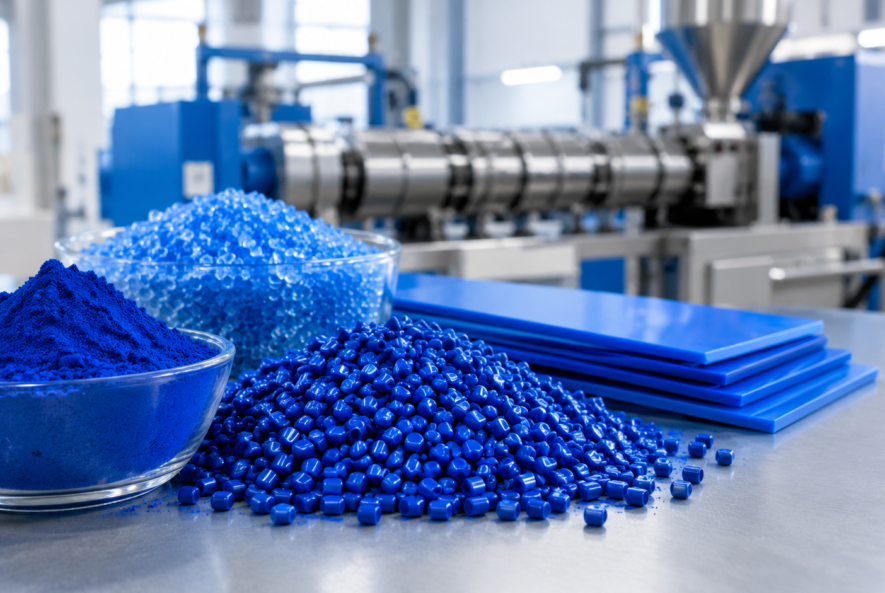
Masterbatch is a concentrated mixture of pigments or additives dispersed in a carrier resin. It is added to the base polymer during plastic processing to achieve the required colour or functionality.
Ultramarine blue can be incorporated into a blue colour masterbatch to provide the required shade.
The general manufacturing process involves the following steps:
Step 1: Pigment selection
The masterbatch manufacturer selects an ultramarine blue grade based on the desired shade, polymer compatibility and processing conditions.
Step 2: Raw material preparation
The pigment and carrier resin are prepared according to the formulation. Any additional ingredients are selected based on the intended masterbatch application.
Step 3: Mixing and dispersion
The pigment is mixed with the carrier resin. Proper dispersion is important because poorly distributed pigment particles can lead to uneven colour and visible defects.
Step 4: Compounding
The mixture is processed through suitable compounding equipment, commonly an extruder. Processing conditions must be controlled to suit the selected pigment and polymer system.
Step 5: Pelletising
The compounded material is converted into pellets. These pellets form the concentrated colour masterbatch.
Step 6: Quality testing
The finished masterbatch is checked for colour consistency, dispersion and other application-specific requirements before being used in plastic manufacturing.
A research study on ultramarine blue in thermoplastics also highlights the importance of compounding conditions and pigment dispersion in achieving consistent colour results.
PubMed Central (PMC)
How to Select the Right Ultramarine Blue Grade for Plastics
Choosing a pigment based only on its colour or price can create production problems. Manufacturers should evaluate the following factors before placing an order.
| Selection factor | What to check |
| Colour shade | Confirm the required blue shade using a sample |
| Heat stability | Match pigment performance with processing temperature |
| Dispersion | Check for uniform distribution in the polymer |
| Polymer compatibility | Test suitability for the intended resin |
| Lightfastness | Evaluate resistance to light exposure |
| Acid resistance | Check exposure conditions and grade suitability |
| Moisture content | Review the supplier’s technical specifications |
| Batch consistency | Compare samples and production batches |
Understand the polymer type
Different polymers have different processing conditions and formulation requirements.
For example, a pigment intended for polypropylene may not automatically be suitable for every PVC or engineering plastic application.
Always confirm compatibility with the actual resin.
Check the processing temperature
Review the temperature range used during extrusion, injection moulding or other production methods.
The pigment must maintain its colour under the actual processing conditions. Ask the manufacturer for grade-specific heat stability information.
Test pigment dispersion
Poor dispersion can result in:
- Uneven colour distribution
- Visible pigment spots
- Streaking on finished products
- Variations between production batches
A laboratory trial or small production trial can help identify these issues before bulk manufacturing.
Request technical documentation
Before finalising a purchase, ask the supplier for:
- Technical Data Sheet (TDS)
- Safety Data Sheet (SDS)
- Colour and shade information
- Heat stability details
- Relevant application and compliance documentation
These documents help procurement and production teams assess whether the pigment meets their requirements.
Common Mistakes to Avoid When Buying Ultramarine Blue
Some pigment-related production issues begin before the material reaches the production line. They are often linked to incorrect grade selection or insufficient testing.
Here are a few mistakes manufacturers should avoid.
1. Selecting only by price: A lower-priced pigment may not meet the required dispersion or processing requirements. Compare technical performance along with the purchase cost.
2. Ignoring polymer compatibility: Always check whether the pigment is suitable for the resin being used.
3. Skipping sample testing: A pigment sample should be tested under actual or representative production conditions before bulk procurement.
4. Overlooking acid sensitivity: Ultramarine blue has limited resistance to acidic environments in standard grades. Check the chemical exposure expected in the final application.
5. Not checking batch consistency: Variations in shade or pigment characteristics can affect finished products. Discuss quality control and batch specifications with the supplier.
How to Choose an Ultramarine Blue Manufacturer in India
For plastic and masterbatch manufacturers, choosing a suitable supplier involves more than comparing quotations.
Consider these points when evaluating an ultramarine blue manufacturer in India:
- Product information: The supplier should provide clear product identification and technical documentation.
- Application understanding: Check whether the supplier can discuss the pigment’s suitability for your intended application.
- Sample availability: Request samples for laboratory evaluation before bulk purchasing.
- Quality consistency: Ask how product specifications and batch consistency are monitored.
- Supply capability: Discuss order quantities, lead times and supply requirements.
- Technical communication: A supplier should be able to address questions about grade selection and application requirements.
ASA Impex operates in the industrial chemicals and pigments segment as a manufacturer, exporter and supplier. Buyers looking for ultramarine blue can refer to its Ultramarine Blue application page for product-related information and enquiries.
Before selecting any grade, share your polymer type, intended application and processing conditions with the supplier. This makes it easier to assess whether the available material matches your production requirements.
Frequently Asked Questions
1. What is ultramarine blue used for in plastics?
Ultramarine blue is used as an inorganic pigment to provide blue colour in plastic products and masterbatch formulations. Its applications depend on polymer compatibility and grade performance.
2. Is ultramarine blue suitable for plastic masterbatch?
Yes. Suitable ultramarine blue grades can be incorporated into colour masterbatch formulations. Proper pigment dispersion, carrier resin compatibility and processing conditions are important.
3. What is the Colour Index number of ultramarine blue?
Ultramarine blue is identified as Pigment Blue 29, with Colour Index number CI 77007.
4. Can ultramarine blue be used in polypropylene and polyethylene?
Certain grades are designed for use in polyolefins such as polypropylene (PP) and polyethylene (PE). However, suitability should be confirmed through technical documentation and application testing.
5. What should manufacturers check before buying ultramarine blue?
Manufacturers should review colour shade, heat stability, dispersion, polymer compatibility, moisture content, acid resistance and batch consistency. Requesting a sample and TDS is recommended.
6. How can I find an ultramarine blue manufacturer in India?
Start by comparing manufacturers and suppliers based on product documentation, sample availability, application knowledge, quality consistency and supply capability. Evaluate the pigment before making a bulk purchase.
Final Takeaway
Ultramarine blue is a useful inorganic pigment for plastic colouring and masterbatch manufacturing. Its bright blue shade and the performance characteristics of suitable grades make it an option for several industrial and consumer plastic applications.
However, selecting the right grade requires attention to polymer compatibility, pigment dispersion, heat stability and the conditions in which the finished product will be used.
For plastic and masterbatch manufacturers, the best approach is to review technical specifications, test samples and discuss application requirements with the supplier before making a bulk purchase.
If your business is looking for an ultramarine blue pigment supplier, ASA Impex can be considered as a point of contact for product-related enquiries.