Colour plays an important role in the manufacturing of plastic products, paints, coatings, printing inks and other industrial materials. For manufacturers, selecting the right pigment is not simply about finding the desired shade. Product consistency, dispersion, heat stability and compatibility with the final application also matter.
Ultramarine blue is one of the commonly used inorganic blue pigments across several industrial applications. It is known for its distinctive blue shade and is identified as Pigment Blue 29 (CI 77007).
For businesses searching for an Ultramarine Blue Pigment Supplier in USA, understanding pigment quality, technical specifications and supplier capabilities can make the purchasing process easier.
Whether you are a plastic manufacturer, paint producer, masterbatch manufacturer or industrial distributor, here are some important factors to consider before choosing a supplier.
Understanding Ultramarine Blue Pigment
Ultramarine blue is an inorganic pigment generally made from sodium aluminium sulfosilicate. Its characteristic blue colour comes from sulphur-containing compounds within its crystalline structure.
Unlike dyes that dissolve in a medium, ultramarine blue works as a pigment that remains dispersed within the material.
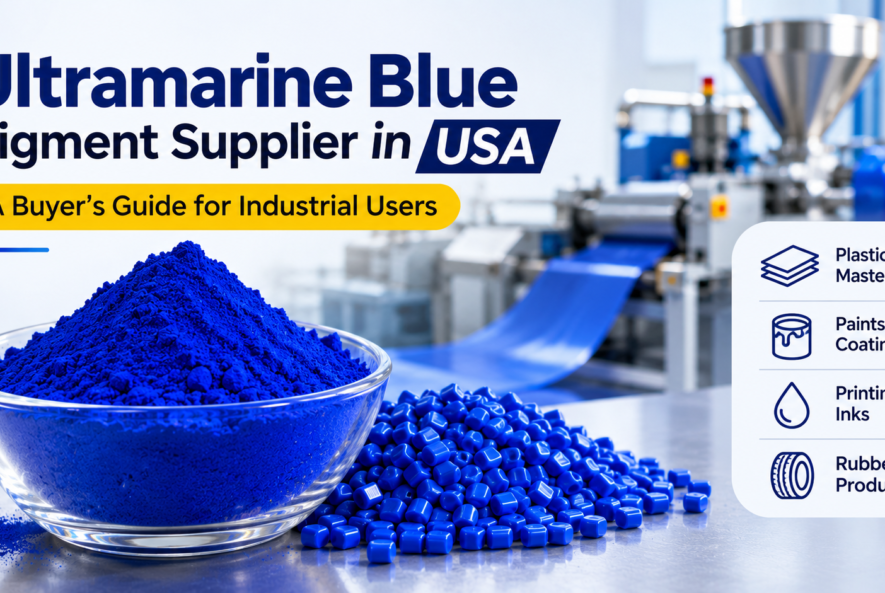
It is used in different industrial applications, including:
- Plastic products and masterbatch
- Paints and industrial coatings
- Printing inks
- Rubber products
- Paper and related applications
- Soaps and detergents
The specific grade required depends on the intended application, processing conditions and performance expectations.
Why Do Manufacturers Use Ultramarine Blue?
Manufacturers select pigments based on their ability to deliver consistent colour and perform under actual production conditions.
Ultramarine blue offers several characteristics that make it relevant to industrial manufacturing.
1. Distinctive blue shade
Ultramarine blue produces a recognisable blue colour that can be used in different formulations. Depending on the grade, manufacturers can select shades with different colour undertones and strengths.
2. Lightfastness
Lightfastness refers to a pigment’s ability to retain its colour when exposed to light. It is an important consideration for plastic products, coatings and other materials that may experience regular light exposure.
3. Heat stability
Plastic manufacturing processes such as extrusion and injection moulding involve elevated temperatures. Manufacturers should select a pigment grade that can withstand their specific processing conditions.
4. Dispersion characteristics
Uniform pigment dispersion helps achieve an even colour throughout the finished product. Poor dispersion can result in streaks, spots and inconsistent shades.
5. Migration resistance
Migration resistance is important when the colour needs to remain within the material rather than transfer to surrounding surfaces. The actual performance depends on the pigment grade and formulation.
It is worth remembering that these characteristics vary between products. Buyers should always check the supplier’s technical data sheet rather than assume that every ultramarine blue grade offers the same performance.
Industrial Applications of Ultramarine Blue
Ultramarine blue is used across several manufacturing sectors. Its suitability depends on the material and the conditions in which the finished product will be used.
Plastics and Masterbatch
Plastic manufacturers use ultramarine blue to produce coloured components, packaging materials, household products and other plastic items.
In masterbatch production, the pigment is dispersed in a carrier resin and converted into concentrated pellets. These pellets are later mixed with the base polymer to achieve the required colour.
The selection process should consider:
- Compatibility with the polymer
- Processing temperature
- Dispersion quality
- Required colour shade
- Light and heat stability
Paints and Coatings
Ultramarine blue is used in selected decorative and industrial coating formulations. It provides blue colour in paints and related products.
The formulation must account for the pigment’s chemical resistance, binder compatibility and intended exposure conditions.
One important consideration is acid sensitivity. Standard ultramarine blue grades generally have limited resistance to acidic environments, so formulation testing is necessary.
Printing Inks
Printing ink manufacturers use pigments to achieve the desired colour and appearance on different substrates.
For ultramarine blue, pigment dispersion, shade consistency and compatibility with the ink system should be evaluated before production.
Rubber Products
Selected ultramarine blue grades can also be used in rubber formulations where blue coloration is required.
The manufacturer should check compatibility with the rubber compound and the processing conditions before selecting a grade.
What Should You Check Before Selecting an Ultramarine Blue Pigment Supplier in USA?
Finding a supplier is only one part of the procurement process. The more important task is determining whether the supplier can meet your product and business requirements.
Here are five factors worth evaluating.
1. Product Specifications and Technical Data
Always request a Technical Data Sheet (TDS) before making a purchase.
The document should provide relevant information such as:
- Colour Index identification
- Colour shade and strength
- Moisture content
- Oil absorption
- pH value
- Heat stability
- Lightfastness
- Chemical resistance
These specifications help your technical team compare products and identify suitable grades.
2. Application-Specific Product Selection
A pigment used in plastic masterbatch may have different requirements from one used in printing inks or coatings.
Explain your intended application to the supplier. Share the base material, processing temperature and required colour characteristics.
This helps avoid selecting a general-purpose grade that may not meet your production requirements.
3. Sample Testing
Do not depend entirely on catalogue descriptions or product photographs.
Request a sample and test it under representative production conditions.
For example, a plastic manufacturer should evaluate pigment dispersion and colour consistency in the actual polymer system before approving the material for bulk production.
4. Supply and Logistics
For US-based procurement teams, delivery arrangements and documentation are important considerations, particularly when sourcing pigments internationally.
Before confirming an order, discuss:
- Product availability
- Minimum order quantity
- Packaging options
- Shipping arrangements
- Estimated delivery time
- Export and customs documentation
These details help procurement teams plan inventory and avoid unnecessary production delays.
5. Communication and Technical Support
A reliable supplier relationship involves more than order processing.
The supplier should be able to provide product information, respond to technical questions and clarify documentation requirements.
Good communication also helps when manufacturers need to evaluate alternative grades or adjust a formulation.
Why Consider International Ultramarine Blue Pigment Suppliers?
US manufacturers are not limited to sourcing pigments from domestic suppliers. International manufacturers and exporters can also be considered when evaluating procurement options.
International sourcing may provide access to different product ranges and manufacturing sources. However, buyers should assess the complete landed cost rather than comparing the product price alone.
Consider the following:
- Product price and freight charges
- Import duties and applicable taxes
- Customs documentation
- Shipping time
- Product specifications
- Supplier communication
- Consistency across orders
For businesses considering an overseas supplier, requesting samples and technical documentation before placing a large order is a sensible approach.
ASA Impex: An Option for Ultramarine Blue Pigment Sourcing
When evaluating an ultramarine blue pigment supplier, businesses should look for clear product information, suitable application guidance and transparent communication.
ASA Impex is an industrial chemicals and pigments manufacturer, exporter and supplier. Its product portfolio includes ultramarine blue along with other industrial chemicals.
Businesses interested in ultramarine blue can refer to the company’s product and application information to understand its offering.
For buyers evaluating potential suppliers, the next step should be to share their application requirements and request relevant product specifications.
You can visit ASA Impex to enquire about ultramarine blue pigment and discuss your sourcing requirements.
Questions to Ask Before Placing a Bulk Pigment Order
Before finalising a supplier, procurement and production teams should clarify a few important points:
- Which ultramarine blue grades are available?
- What are the technical specifications of each grade?
- Is the selected grade suitable for the intended application?
- Can the supplier provide samples for testing?
- What packaging and order quantities are available?
- What documentation is provided for international shipments?
- What are the expected production and shipping timelines?
Getting these answers in advance can help businesses make better purchasing decisions.
Frequently Asked Questions
What is ultramarine blue pigment used for?
Ultramarine blue is an inorganic pigment used to provide blue colour in plastics, masterbatch, paints, coatings, printing inks, rubber and other industrial products.
What is the Colour Index number of ultramarine blue?
Ultramarine blue is classified as Pigment Blue 29, with Colour Index number CI 77007.
How do I select the right ultramarine blue pigment?
Consider the intended application, colour shade, heat stability, lightfastness, dispersion, chemical resistance and compatibility with the base material. Always review the technical data sheet and test a sample.
Can ultramarine blue be used in plastic masterbatch?
Yes. Suitable grades can be incorporated into plastic masterbatch formulations. Proper dispersion, polymer compatibility and processing conditions should be evaluated before production.
Can US businesses purchase ultramarine blue from international suppliers?
Yes. Businesses can evaluate international manufacturers and exporters as potential sourcing partners. They should check product documentation, shipping arrangements, import requirements and total landed costs.
Final Thoughts
Choosing an ultramarine blue pigment supplier requires attention to both product quality and supply requirements. A suitable pigment should meet the technical needs of the application while providing consistent performance during manufacturing.
For US-based manufacturers and distributors, comparing domestic and international suppliers can help identify suitable sourcing options.
Before placing a bulk order, review technical specifications, request samples and confirm shipping arrangements. These steps can help reduce procurement risks and support more consistent production outcomes.