When manufacturers look for an Ultramarine Blue Pigment Supplier in USA, they need more than a source of blue colour. They need a pigment that suits their production process, delivers the required shade and performs consistently in the finished product.
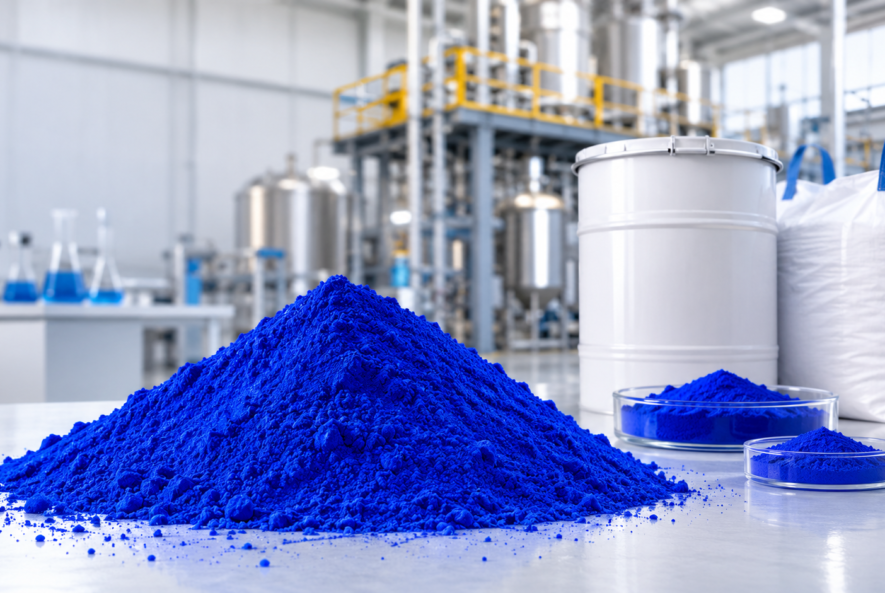
Ultramarine Blue is a synthetic inorganic pigment used in plastics, paints, coatings, printing inks, rubber, detergents, textiles and paper manufacturing. Its bright blue appearance and ability to reduce unwanted yellow tones make it useful across several industrial applications.
However, not every grade is suitable for every manufacturing process. Particle size, colour strength, dispersion, heat stability and chemical resistance can influence the final result.
For procurement teams and industrial buyers, understanding these factors makes supplier selection easier and helps avoid problems during production.
What Is Ultramarine Blue Pigment?
Ultramarine Blue is a synthetic inorganic blue pigment commonly identified as Pigment Blue 29 (PB 29) under the Colour Index system. Its Colour Index number is C.I. 77007.
It is based on a sodium aluminosilicate sulphur-containing structure that produces its characteristic blue colour.
Unlike soluble blue dyes, Ultramarine Blue is used as an insoluble colour pigment. It is incorporated into materials through suitable mixing and dispersion processes.
Manufacturers use it for two main purposes:
- Colouring: Adding bright blue shades to plastics, paints, inks, rubber and other products.
- Whitening correction: Reducing the visual effect of unwanted yellow tones in white materials.
The second application is particularly relevant in laundry products, detergents, paper and selected plastic applications.
Why Do Manufacturers Use Ultramarine Blue?
Ultramarine Blue has a distinct combination of colour characteristics that makes it useful in different industrial formulations.
Bright blue shade. The pigment produces a clear blue appearance that can be adjusted through formulation and blending.
Whitening effect. Small quantities can help counteract some yellow tones in certain white materials. This is why the pigment is used in laundry and detergent applications.
Light stability. Suitable grades offer good resistance to colour fading under light exposure. Actual performance depends on the grade and application conditions.
Heat resistance. Certain Ultramarine Blue grades can withstand elevated processing temperatures, making them useful in selected plastic manufacturing processes.
Versatile industrial applications. It can be used in different formulations, including paints, plastics, rubber, inks, paper and detergents.
One important limitation deserves attention: conventional Ultramarine Blue has relatively poor acid resistance. Buyers should check chemical compatibility before using it in acidic formulations.
Industrial Applications of Ultramarine Blue Pigment in the USA
Plastics and Masterbatch Manufacturing
Plastic manufacturers use Ultramarine Blue to add colour to different polymer products. Common applications include plastic containers and household products, PVC pipes and components, packaging materials, plastic films and sheets, and colour masterbatches. In masterbatch manufacturing, the pigment is concentrated in a carrier resin before being incorporated into the final polymer. Buyers should check heat stability, dispersion quality and compatibility with the polymer being processed.
Paints and Coatings
Paint manufacturers use Ultramarine Blue to produce blue shades in decorative and industrial coatings. It can be considered for decorative paints, industrial coatings, powder coatings, selected protective coating formulations and colour blending applications. The final appearance depends on pigment concentration, particle distribution, binder compatibility and the other ingredients in the formulation.
Detergent and Laundry Products
One established application of Ultramarine Blue is laundry whitening. A small amount of blue colourant can visually counterbalance some yellow tones, making fabric appear brighter. Detergent manufacturers use suitable grades in laundry detergent powders, fabric washing products, laundry blue formulations and textile brightening products. Excessive addition can leave visible blue marks.
Rubber Manufacturing
Ultramarine Blue is also used in rubber products where a blue shade is required. Potential applications include rubber sheets, footwear components, moulded rubber products and industrial rubber components. Manufacturers should evaluate heat exposure, colour consistency and compatibility with the rubber formulation.
Printing Inks
Printing ink manufacturers use Ultramarine Blue to develop specific blue shades in selected ink systems. The pigment can be considered for packaging, stationery and other printed materials. Important factors include particle size, dispersion, tinting strength and compatibility with the ink vehicle.
Paper and Textile Industries
Paper manufacturers may use Ultramarine Blue for shade correction and blue coloration. In textile-related applications, selected formulations use the pigment to produce blue shades or improve the visual appearance of certain materials. The required grade depends on the production process and end-use requirements.
Important Properties to Check Before Buying Ultramarine Blue
Colour strength and shade. Colour strength determines how effectively a pigment produces the desired shade at a particular concentration. Ask for a representative sample and compare it against your approved colour standard.
Particle size. Particle size affects dispersion, surface finish and colour development. A suitable particle-size distribution helps manufacturers achieve the desired appearance.
Heat stability. For plastic processing and other heat-intensive applications, the pigment must withstand the temperature conditions involved. Request grade-specific information.
Acid and alkali resistance. Conventional Ultramarine Blue generally has poor acid resistance, although performance varies by grade and formulation. Buyers should test compatibility where acidic ingredients or conditions are involved.
Moisture and soluble matter. Moisture and water-soluble impurities can affect processing and formulation consistency. Review the technical data sheet for these parameters.
Dispersion quality. Poor dispersion can result in uneven colour, visible particles or spots, inconsistent shade between batches, and production difficulties. A production trial is a practical way to evaluate this characteristic.
How to Choose a Reliable Ultramarine Blue Pigment Supplier in USA
- Check the supplier’s product knowledge. The supplier should understand the difference between general-purpose and application-specific pigment grades and discuss the needs of different manufacturing processes.
- Request a technical data sheet. Check relevant details such as Colour Index identification, colour shade and strength, particle size, moisture content, oil absorption, heat stability, and acid and alkali resistance.
- Ask for a representative sample. Test the sample in your existing formulation and production conditions before committing to a commercial order.
- Review batch consistency. Ask how product batches are checked and whether batch-specific quality documentation is available.
- Understand packaging and shipping. For overseas procurement, confirm packaging, order quantity, shipping terms, destination handling requirements and expected delivery schedule.
- Compare the total procurement cost. Consider performance, required dosage, wastage, shipping charges, import costs and consistency rather than comparing quoted prices alone.
Common Mistakes to Avoid When Purchasing Ultramarine Blue
- Selecting a pigment without checking its compatibility with the formulation.
- Ignoring acid resistance.
- Assuming all grades have the same heat stability.
- Purchasing large quantities without conducting a sample trial.
- Comparing quotations without checking technical specifications.
- Overlooking packaging and transportation arrangements.
- Failing to confirm applicable regulatory requirements for the intended end use.
A clear technical evaluation before ordering can reduce unnecessary production issues.
Why Consider ASA Impex for Ultramarine Blue Pigment Requirements?
For businesses evaluating an Ultramarine Blue Pigment Supplier in USA, international suppliers can also be considered as part of their procurement process.
ASA Impex is an industrial chemical and pigment manufacturer, exporter and supplier based in New Delhi, India. The company has been serving industrial sectors since 1976.
Its product portfolio includes Ultramarine Blue pigments for applications across plastics, paints, coatings, detergents, rubber, printing inks, textiles and paper.
The company focuses on supplying industrial chemical and pigment solutions to manufacturing businesses.
For American buyers considering an overseas sourcing option, it is worth discussing the following requirements directly:
- Intended industrial application.
- Required colour shade and grade.
- Technical specifications.
- Sample evaluation requirements.
- Order quantity and packaging.
- Export availability and shipping arrangements to the USA.
ASA Impex can be approached to discuss product requirements and obtain further information about its Ultramarine Blue pigment range.
You can review the Ultramarine Blue pigment applications: https://asaimpex.in/ultramarineblue-application/
Final Thoughts
Selecting an Ultramarine Blue Pigment Supplier in USA requires more than finding a company that offers blue pigment at a competitive price.
Manufacturers should evaluate colour strength, dispersion, particle size, heat stability and chemical resistance according to their production requirements.
It is equally important to review technical documentation, test samples and understand supply arrangements before placing bulk orders.
Whether you manufacture plastics, paints, rubber, detergents or printing inks, a well-evaluated pigment source can help maintain consistent colour and reduce avoidable production problems.
ASA Impex offers Ultramarine Blue pigment solutions for industrial applications. Businesses interested in overseas sourcing can contact the company to discuss their requirements and confirm export availability.